search-icon
A Busy Weekend ROV -ing

Throughout the weekend, our Global Reef Expedition research team continued to crank out dives and surveys in the far northeast corner of Cay Sal Bank.  Tomorrow afternoon, following our team’s morning dives, the M/Y Golden Shadow will leave its current anchorage at Dog Rocks to move westward on to new survey territory.

Early yesterday evening, Executive Director Phil Renaud brought out the foundation’s Remotely Operated Vehicle (ROV) for a test run off the stern of the Shadow. Along with NCRI’s Dr. Sam Purkis and the Shadow’s Electronics Officer Brian Meskell, Phil prepped the ROV for its first deployment of the expedition. Slowly, but surely, the entire expedition team made its way to the aft deck to watch the activities as Phil drove the ROV along the reef.
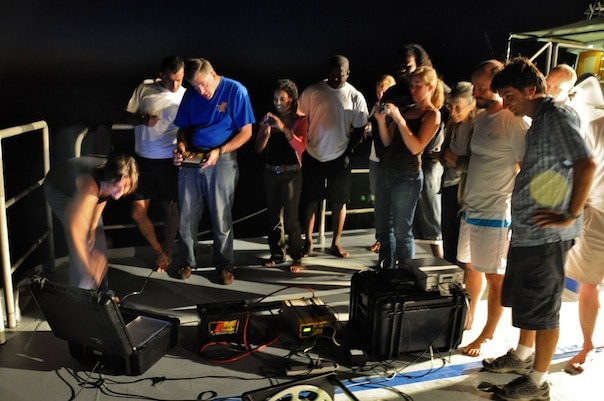
Phil drove the ROV along the reef

The ROV is a very useful addition to our expedition toolkit. The Seabotix LBV-150 ROV has a maximum operating depth of 150 meters, or roughly 500 feet, so it can survey the area below diver depth and it also allows our team to continue exploring the reef in the evenings when our SCUBA diving is finished for the day.

It was a gorgeous night on Cay Sal Bank with flat, calm water and clear skies, so it was nice to gather outside and check out the happenings on the seafloor below.
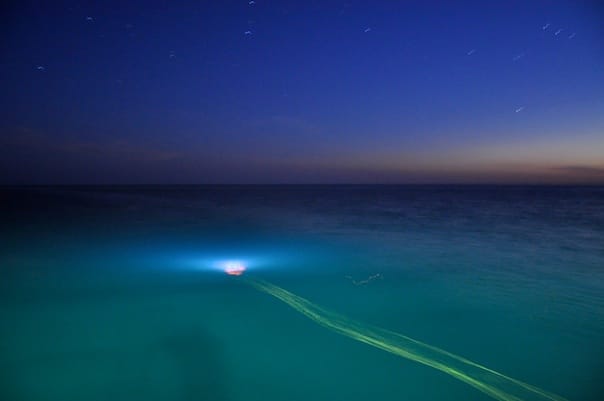
You can see how calm the waters were in the image above: the ROV is a few feet underwater with its lights on and the yellow streak is its tether back to the monitor and steering controls.

During the day, our newest expedition members are getting their fins wet and have quickly become part of the team. AGRRA experts Judy Lang and Ken Marks have been working with our new divers in the evenings on coral and fish identifications, so they can survey sites with the rest of the team in the mornings and afternoons.
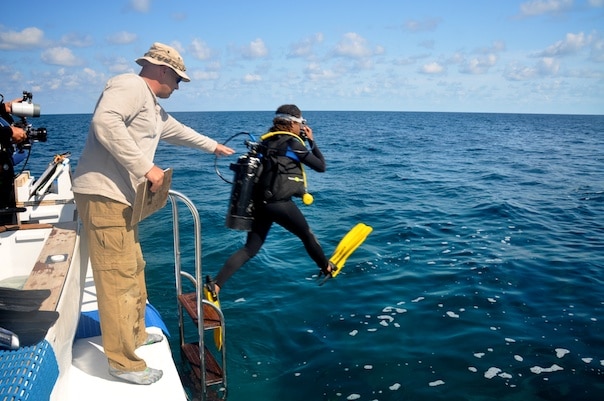
This afternoon, the team dove again off the M/Y Golden Osprey. In the photo above, Dive Safety Officer (DSO) Tim Payne assists Bahamian Alannah Vellacott with her giant stride into the water. Alannah is a biology student at The College of the Bahamas and we’re excited to have her aboard on our survey team.

We also now have a two-person film crew on board, so we welcome Charles Kinder and Bill Mills to the team. They have been filming all of our activities as well as diving with the survey teams to capture the action underwater.
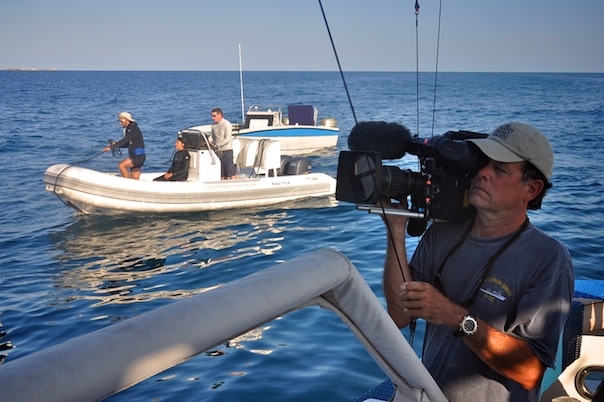
In this shot, Bill films as the Golden Osprey arrives back at the Shadow after a day of diving. In the background, another team of divers is also arriving back at the Shadow at the same time. With Chief Officer Andy Breach driving the tender, Living Oceans Foundation Fellow Dr. Sonia Bejarano and Dr. Bernhard Riegl return from a quick trip to pick up Sonia’s underwater cameras off the seafloor.

To follow along and see more photos, please visit us on Facebook! You can also follow the expedition on our Global Reef Expedition page, where there is more information about our research and our team members.

Post by Liz Smith

(Image credits: Liz Smith)
Related Posts

From Dialogue to Action: Ocean Foundations Gather in Stockholm

What can philanthropy accomplish when foundations working across ocean science, conservation, and sustainable development come together around a shared purpose?

That question was at the heart of the 6th UN Ocean Decade Foundations Dialogue, held September 7–9 in Stockholm, Sweden. The Khaled bin Sultan Living Oceans Foundation joined philanthropic organizations from around the world for three days of discussion, collaboration, and planning focused on accelerating progress during the second half of the UN Decade of Ocean Science for Sustainable Development.

Facilitated by UNESCO’s Intergovernmental Oceanographic Commission (IOC), the UN Ocean Decade Foundations Dialogue is a growing network of more than 30 philanthropic organizations committed to advancing ocean science, collaboration, and action. Since its creation within the framework of the Ocean Decade, the Dialogue has provided foundations with a space to exchange ideas, develop partnerships, and explore how philanthropy can help advance a healthy and resilient ocean.

Hosted by the Voice of the Ocean Foundation (VOTO), this year’s gathering began with From Depth to Action, an Opening Forum that brought nearly 100 leaders from the Swedish and international ocean community together at…

Read More

Meet IFAN: Helping Bring Navigate with Care to the Next Generation

If you’ve ever seen a lighthouse flashing from the shore or a brightly colored buoy bobbing in the water, you’ve seen Aids to Navigation at work.

Aids to Navigation, often called AtoNs, help mariners navigate safely. They can mark channels, warn of hazards, help vessels determine their position, and provide other information people need to make safe decisions on the water. Around the world, these systems help guide everything from small recreational boats to large commercial or container ships. 

But safe navigation isn’t only about protecting vessels and the people aboard them. The choices mariners make can also affect the animals and ecosystems beneath and around them.

That connection between maritime safety and ocean conservation is at the heart of this year’s Science Without Borders® Challenge—and of our partnership with this year’s theme sponsor, the International Foundation for Aids to Navigation (IFAN).

Read More
Privacy Overview

This website uses cookies so that we can provide you with the best user experience possible. Cookie information is stored in your browser and performs functions such as recognising you when you return to our website and helping our team to understand which sections of the website you find most interesting and useful.  You can view our complete Privacy Policy here.

Strictly Necessary Cookies

Most of our cookies are used to improve website security and reduce spam. These cookies should be enabled at all times. They also enable us to save your preferences for cookie settings.

3rd Party Cookies

This website uses Google Analytics to collect anonymous information such as the number of visitors to the site, and the most popular pages. Keeping this cookie enabled helps us to improve our website.