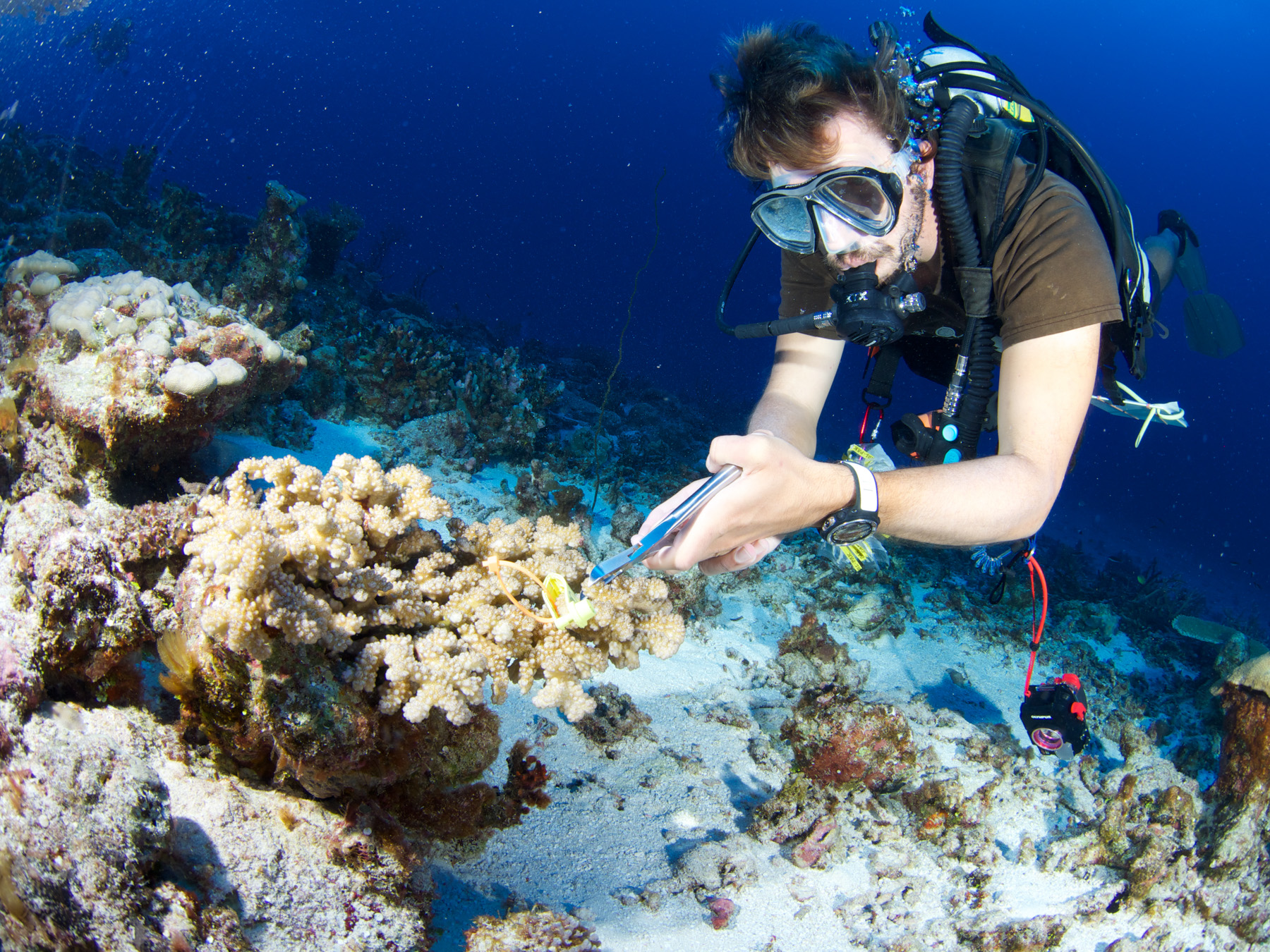
The Living Oceans Foundation launched our fellowship program, which sponsored graduate students and post-doctoral researchers to conduct applied research that will contribute to improved management and conservation of coral reefs. Fellows were selected annually through a competitive application process and received $35,000 of financial support per year for up to four years to support their research, and were often invited to participate in our scientific research missions.
Embracing our philosophy of supporting Science Without Borders®, the Living Oceans Foundation fellowship program welcomed scientists from around the world, regardless of citizenship or nationality, with a career interest in coral reef science or management. In addition to graduate students and post-docs working at a university, the program also welcomed recent graduates employed by a government agency and conducting research on coral reef conservation and management.
The Khaled bin Sultan Living Oceans Foundation has honored 15 scholars with research fellowships, who have joined us on all of our major research expeditions to the South Pacific, Indian Ocean, Caribbean, and the Red Sea, including:
- Tracy J. Mincer, a PhD student at Scripps Institution of Oceanography at University of California San Diego. The KSLOF Fellowship supported his work to investigate the potential use of unique marine actinomycetes as a new biomedical resource.
- Mary Engles, a graduate student at the University of Hawaii studying geology and geophysics. Her KSLOF Fellowship supported her work using airborne remote sensing, diver ecological surveys, and wire-line drill coring to determine the response of Hawaii’s largest fringing reef to changing environmental influences over the past 10,000 years.
- Justin Prosper, who used his KSLOF Fellowship to complete a graduate program in Geographic Information Systems at the University of Edinburgh and return to the Seychelles to put his skills to use at the Ministry of the Environment and Natural Resources.
- Arfang Diamanka and Aminita Sene, graduate students at the University Cheikh Anta DIOP of Dakar, who studied diseases in the cultured fishes in Senegal under the supervision of KSLOF scientists.
- Alex Venn, a PhD student working at the Bermuda Institute of Ocean Sciences (BIOS) on the impact of environmental stressors on corals and their symbiotic algae. He used his KSLOF fellowship to develop gene-based markers of coral stress to build the capacity for improved means of coral health assessment.
- Gwilym Rowlands, a PhD student at the National Coral Reef Institute (NCRI) at Nova Southeastern University. He used his Fellowship to develop powerful spectral remote sensing techniques to allow scientists to investigate coral reef processes over space and time.
- Sarah Hamylton, a post-doctoral scholar working on marine resource management at Southampton University, joined us on our research missions to the Red Sea.
- Renata Farreri, a doctoral student at the University of Exeter working with Pete Mumby. She used her KSLOF Fellowship to join us on the Global Reef Expedition to study the effects of coral-algae competition on the growth rate and mortality of coral colonies.
- Jeremy Kerr, a doctoral student working under Dr. Sam Purkis at Nova Southeastern University. His KSLOF Fellowship allowed him to participate in Global Reef Expedition missions in the Caribbean, Pacific, and Indian Oceans, mapping coral reefs using a combination of satellite imagery and field observations.
- Sonia Bejarano, a post-doctoral scholar from Colombia, who joined the GRE missions in the Caribbean and in French Polynesia to study fish grazing as a source of reef resilience.
- João Monteiro, a PhD student who joined Global Reef Expedition on many of our research missions in the Pacific Oceans to study Symbiodinium spp.
- Badi R. Samaniego, a doctoral student at the University of the Philippines working on coral reef fish ecology. His KSLOF Fellowship allowed him to participate in most of the GRE missions to the Pacific and Indian Oceans and study reef fish communities.
- Anderson Mayfield, a post-doctoral scholar working on coral genetics at the National Museum of Marine Biology and Aquarium in Taiwan. His KSLOF Fellowship allowed him to sample corals from various locations visited on the Global Reef Expedition.
- Steve Saul, a post-doctoral scholar working at the National Marine Fisheries Service. For his KSLOF Fellowship, he developed models that look at how coral reef-dependent fisheries can most appropriately be managed to meet subsistence needs while protecting biodiversity in small island developing states.