Changing Tides
As the crew and science team watched from the M/Y Golden Shadow, a bigger, brighter moon filled the night sky rising above the island of Vanuabalavu on June 23, 2013. When the moon is closest to Earth, called perigee, it


As the crew and science team watched from the M/Y Golden Shadow, a bigger, brighter moon filled the night sky rising above the island of Vanuabalavu on June 23, 2013. When the moon is closest to Earth, called perigee, it
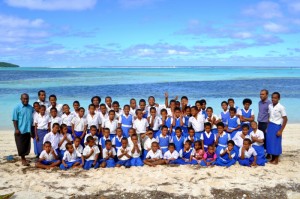
Roko Laitia Raloa, Assistant Roko Tui Lau at the Lau Provincial Council’s Office, and I are greeted at the boat tender by the head teacher of the primary school to which we are presenting our talk on Fiji coral reef
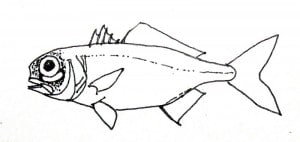
Bioluminescence occurs when a biological organism produces a chemical reaction where energy is released in the form of light. A familiar example of bioluminescence is the firefly, emitting a yellow-green light. In the marine environment, most bioluminescence appears as a
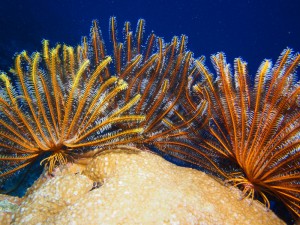
One of the most unusual group of animals found on the reef are the echinoderms. So named because of their “spiny skin”, these animals are pentamerous or radially symmetrical (five point). Found only in the sea, they include sea urchins,
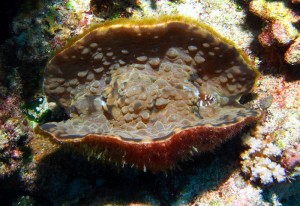
Restocking giant clams requires patience and lots of nurturing. The overall process can take as long as 3 years to grow a giant clam that is able to be sold to the aquaria trade and even longer for meat production.
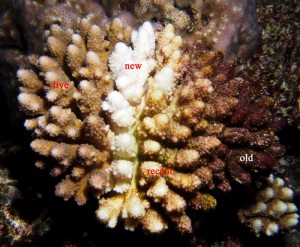
Reef building corals start out from a small larvae (planula) that settles onto the reef, or from a fragment that has broken off another colony. The polyps that make up the coral divide, repeatedly, into two or more daughter polyps,
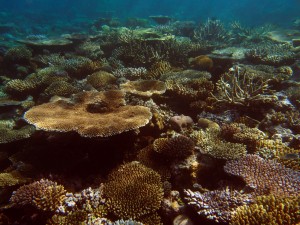
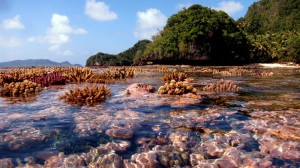
Fiji’s coral reefs house some 333 species of corals of all shapes, sizes and colors, many of which we’ve seen in Lau Province. We’ve examined many reef types, some which fringe the shore (fringing reefs), some in the center of
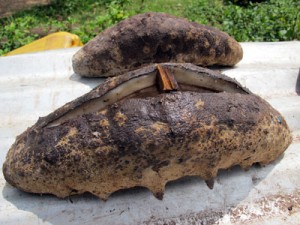
Throughout the Lau Province it’s typical to find sea cucumbers drying in the sun. The dried sea cucumbers are called beche-de-mer. These sea cucumbers fetch a good price and for some islands it has become their primary source of income.
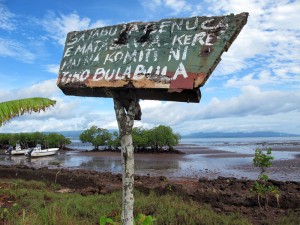
Across the world, coral reefs and fisheries are in crisis. In Fiji over the past few decades, increased demands for cash income and material goods, coupled with growing populations and access to markets, have led to substantially increased pressure on
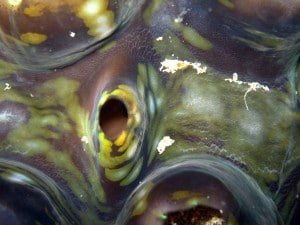
For those of you who have never seen a giant clam, let me tell you they are incredible creatures. I’m intrigued by these enormous, marble-colored flesh animals. Their size alone is impressive with potential to grow up to almost 5