search-icon
Dartfishes

Expedition Log: Palau – Day 16

For the past few weeks I have descended into Palau’s waters each day with my two vital pieces of equipment: a tape measure reel and writing slate. My job on this mission is to count, identify and measure reef fish throughout Palau’s reefs. Before this trip I never really had much appreciation for the very small reef fish, unlike my fellow fish surveyor Stefan. Instead I am drawn to the larger and more charismatic members of the reef. That was until I started counting dartfishes.

zebra dartfish Ptereleotris zebra
Zebra Dartfish (Ptereleotris zebra)
(Click-thru on image for greater detail.)

Dartfishes are small, elegant elongate reef fish from the family Microdesmidae and subfamily Ptereleotrinae. There are 20 species worldwide, and Palau contains 11 of these. So far, the fish team has managed to spot and ID six species—Fire Dartfish (Nemateleotris magnifica), Twotone Dartfish (Ptereleotris evides), Spottail Dartfish (Ptereleotris heteroptera), Monofin Dartfish (Ptereleotris monoptera) and Zebra Dartfish (Ptereleotris zebra)—and we seem to find at least one of these species during each dive in Palau. I’ve learned that the best place to spy these enigmatic little fish is hovering individually, in pairs or in small groups just above the seabed. As the dartfish hover they feed on tiny zooplankton from the water column. Most species are known to occur in relatively shallow waters, although one South African species, Ptereleotris lineopinnis, is found only in depths greater than 90m!

fire dartfish Nemateleotris magnificafire dartfish Nemateleotris magnifica
Fire Dartfish (Nemateleotris magnifica)
(Click-thru on image for greater detail.)

I have also learned that these beautiful fish are aptly named. As soon as I get too close with my tape measure or camera, they dart straight into their sandy burrow or under a rock. Unfortunately for them, they are very photogenic and appealing and the fish team are very persistent; so we have managed to snap a few photos!
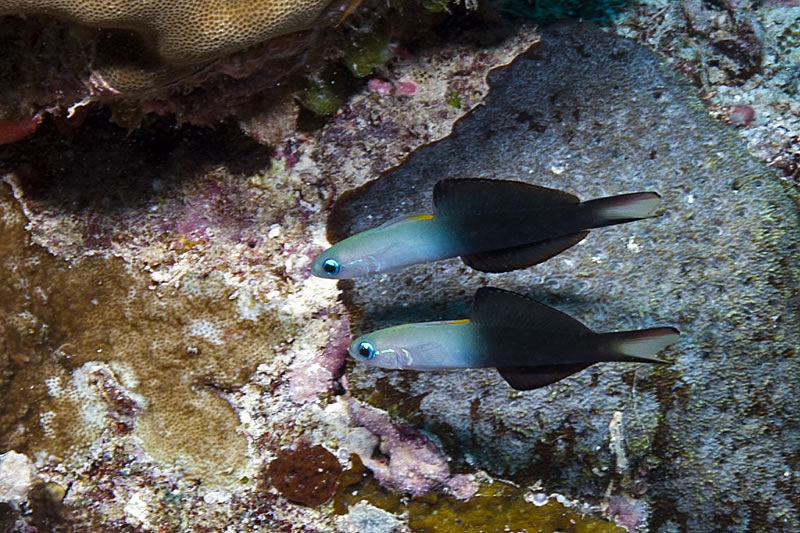
  twotone dartfish Ptereleotris evides
Twotone Dartfish (Ptereleotris evides)
(Click-thru on image for greater detail.)

Photos by Ken Marks.
Related Posts

From Mangrove Mud to Meaningful Work: Desta’s J.A.M.I.N. Journey

Some students I remember for their grades, their quick answers, or a moment that made the whole class laugh. Others I remember for the way they stepped into the mangroves.

Desta was the kind of student who thrived outdoors. While some students hesitated at the edge of the mud, he walked right in. And when he inevitably got stuck — because everyone does — he didn’t get frustrated. He laughed. Covered in mud, holding mangrove propagules in his hands, he embraced the experience fully.

Even then, it was clear that he was connecting with the environment in a way that went beyond the lesson plan…

Read More

From Students to Stewards: A Full-Circle Moment for J.A.M.I.N.

There are certain faces you never forget.

Over the years, hundreds of students have stepped into mangrove forests with us through the Jamaica Awareness of Mangroves in Nature (J.A.M.I.N.) program. I may not always remember every name, but I remember the expressions — the hesitation before stepping into thick mud, the laughter when someone loses a shoe, the look of surprise when they catch that unmistakable sulfur smell rising from the mangrove soil…

Read More
Privacy Overview

This website uses cookies so that we can provide you with the best user experience possible. Cookie information is stored in your browser and performs functions such as recognising you when you return to our website and helping our team to understand which sections of the website you find most interesting and useful.  You can view our complete Privacy Policy here.

Strictly Necessary Cookies

Most of our cookies are used to improve website security and reduce spam. These cookies should be enabled at all times. They also enable us to save your preferences for cookie settings.

3rd Party Cookies

This website uses Google Analytics to collect anonymous information such as the number of visitors to the site, and the most popular pages. Keeping this cookie enabled helps us to improve our website.