The hunt for marine invertebrates begins…
It is 6:30 in the morning, and Nathaniel (“Nat”) Evans and Daphné Grulois depart with the film crew (Alison Barrat, Ernie Kovacs) to Surprise Atoll. Depositing Alison and Ernie at their filming location, Nat and Daphné move on to a couple of sheltered reefs a few miles away.
Working with mask and snorkel, Daphné searches for giant clams in the shallows, a continuation of the work Dr Cécile Fauvelot began at the start of the New Caledonia Mission, Unraveling Algal Biodiversity. Meanwhile, Nat seeks out areas of rock, rubble, or sediment and sets to work collecting marine invertebrates – animals without a backbone. Nat collects invertebrate specimens that are easily seen with the naked eye such as crabs, worms, nudibranchs, seastars, urchins, and sea cucumbers.
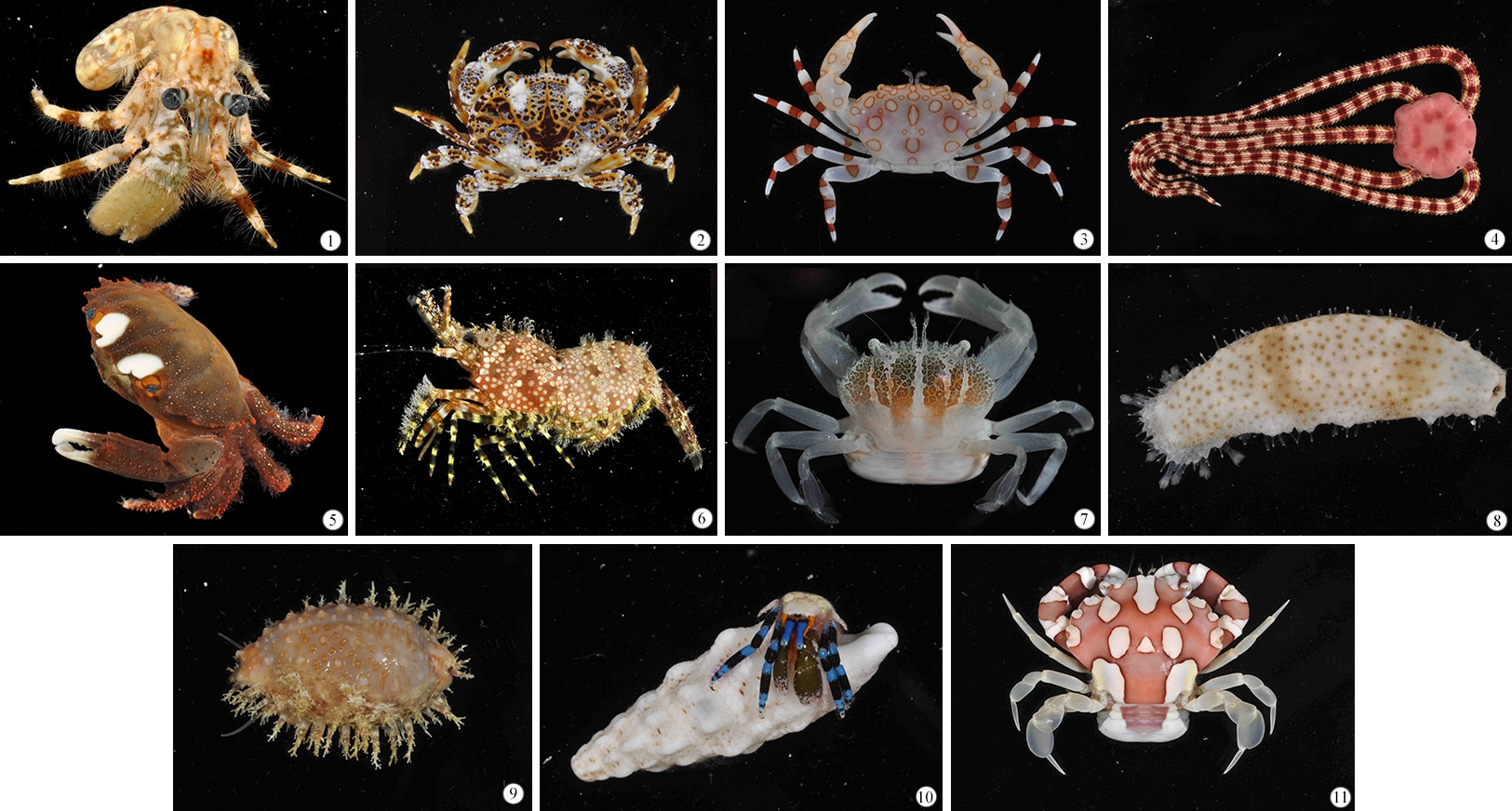
Marine Invertebrate Samples collected and photographed.
Some marine invertebrates are easily spotted, however others are cryptic, hiding within the reef, under rocks and ledges, in amongst the algae, and sand. Often they are exceedingly well camouflaged. Nat’s invertebrate collection method is known as “hand grabbing”. As the name would suggest Nat’s method is not particularly subtle, but it is incredibly effective and has a certain art. Nat will lift small rocks in search of the creatures cowering beneath. Watching and carefully noting where the animals scuttle, Nat then prepares his sample bag, before sneaking up and grabbing the specimens of interest. To focus his effort, Nat exercises his almost encyclopedic knowledge of the invertebrate collection housed where he works at the Florida Natural History Museum, and keeps a mental note of what he has collected so far on the expedition.
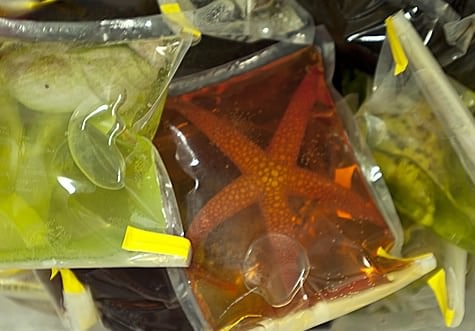
Specimens are individually preserved for transport back to the museum invertebrate collection, where they will be identified and catalogued.
Marine Invertebrate Collection Fills New Caledonia Biodiversity Hole
Several scientists at the Institute of Research for Development (IRD, which partnered with the Foundation to organize this expedition), are long term collaborators with Nat’s lab in Florida. They have often join forces to investigate taxonomy, biogeography, systematics and evolution of invertebrate, and also flora, in expeditions carried out in New Caledonia, French Polynesia, Vanuatu and Papua New Guinea. This work continues the tradition of marine biodiversity study that has been carried out in New Caledonia since more than 70 years. However, even if a lot is known on New Caledonia reefs, there is still a lot to be discovered and described.
Back on board the Golden Shadow, Nat prepares the specimens for storage in the invertebrate collection. Specimens are painstakingly photographed to show their natural colors, before being preserved for display. A small tissue sample is taken to generate DNA barcodes for each species. Collections such as the one Nat’s work contributes to serve a wide community of biologists interested in topics such as taxonomy, evolutionary development, and the geographic distribution of species. Nat’s sampling fills the New Caledonia ‘hole’ in the collection and will support the work of scientists both locally and around the globe. In but a few months all the specimens so painstakingly collected and catalogued will be searchable within the online database.
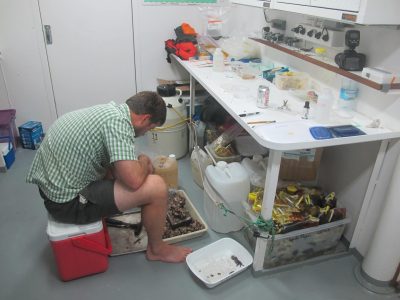
Back in the lab, Nat works through the marine invertebrate specimens he has collected in the field.
Specimen Photos:
1. Pagurus hirtimanus
2. Zosimus aeneus
3. Xanthid
4. Ophiarachnella macracantha
5. Etisus dentatus
6. Saron marmoratus
7. Caphyra laevis
8. Bohadschia koellikeri
9. Staphylaea
10. Calcinus elegans
11. Lissocarcinus laevis
Photos 1-11: Nathaniel Evans, 12-13: Gwilym Rowlands