Expedition Log: Palau – Day 6
When our benthic team is conducting surveys, we are usually looking down at the benthos, concentrating and writing furiously on our dive slates. We often come back to the boat and hear excited questions from the fish team of ‘Did you see that __________?!’ And the answer is usually no (followed by us asking if they saw that gorgeous nudibranch or other benthic creature, to which they have to say no!). But occasionally we will glance up at the right moment and are rewarded with a site of a majestic manta ray or shark. Today, one of the most dazzling displays we got to see was a school of large, silvery pelagic fish feeding in the water column. The way the light reflects off different individuals as they move in the sunlight, and the way the shape of the school twists and turns in a fluid harmony that even mathematicians haven’t cracked the code of, makes for a mesmerizing spectacle.
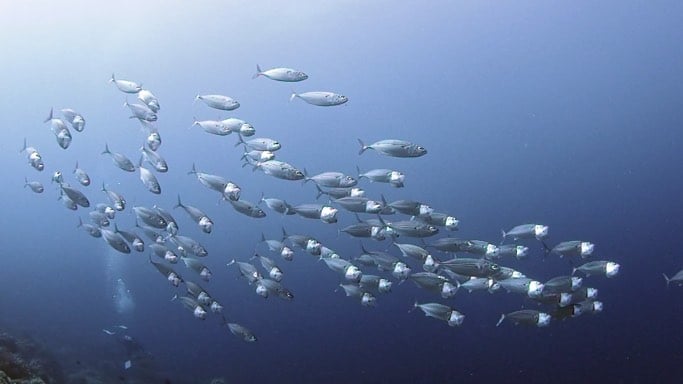
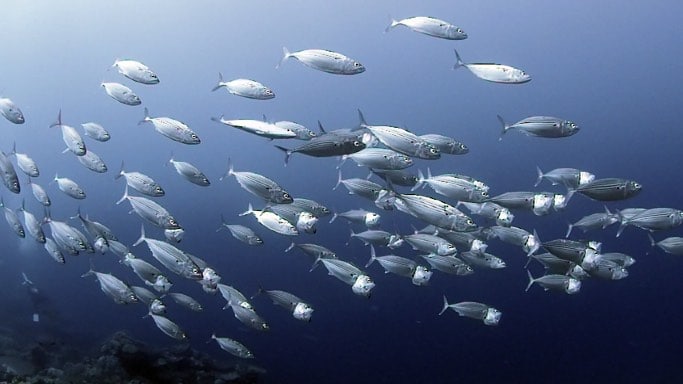
Two images of schools of Longjawed Mackerel (Rastrelliger kanagurta)
(Click-thru on images for greater detail.)
On one of our first dives, we happened to look up to see a school of pelagic fish most of us had never seen before. From a distance, they looked like they had a white triangle in front of their gills, but as we got closer we could see that it was the typical silvery color highlighted by the sun so it looked brighter than the rest of their bodies. Why would all of their jaws be reflecting light at once even though they’re in different positions? That is odd, I thought to myself. Through the zoom lens of my camera, I was able to see the explanation – these fish had an unusually long jaw and their mouth was open. The flare of it was catching the light!
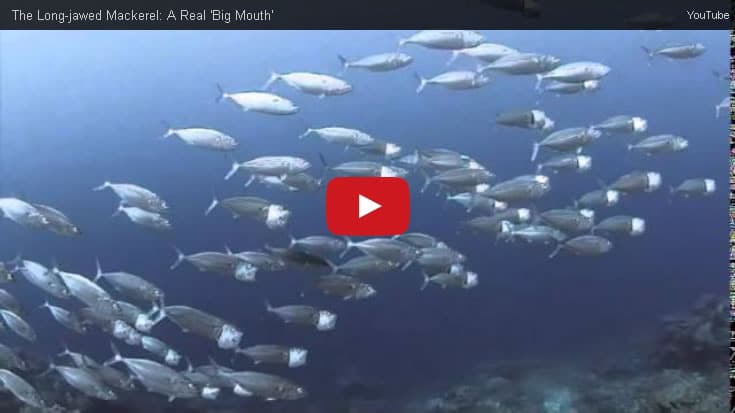
Video of Longjawed Mackerel filtering zooplankton from the water for food
These weird and wonderful fish are the Longjawed Mackerel (Rastrelliger kanagurta). They swim around with their mouths open and gill rakers exposed, filtering zooplankton from the water for food. They swim in densely packed schools and are widespread throughout the Indo-Pacific, but this was our first glimpse of them on the Global Reef Expedition. That evening the Longjawed Mackerel was at the top of the ‘Did you see that?!’ list for the lucky few of us that got to observe them!

A close-up of a school of longjawed mackerel sifting the water for plankton.
Photos: 1,2 – Joao Monteiro; 3 – Andy Bruckner
Video by Joao Monteiro