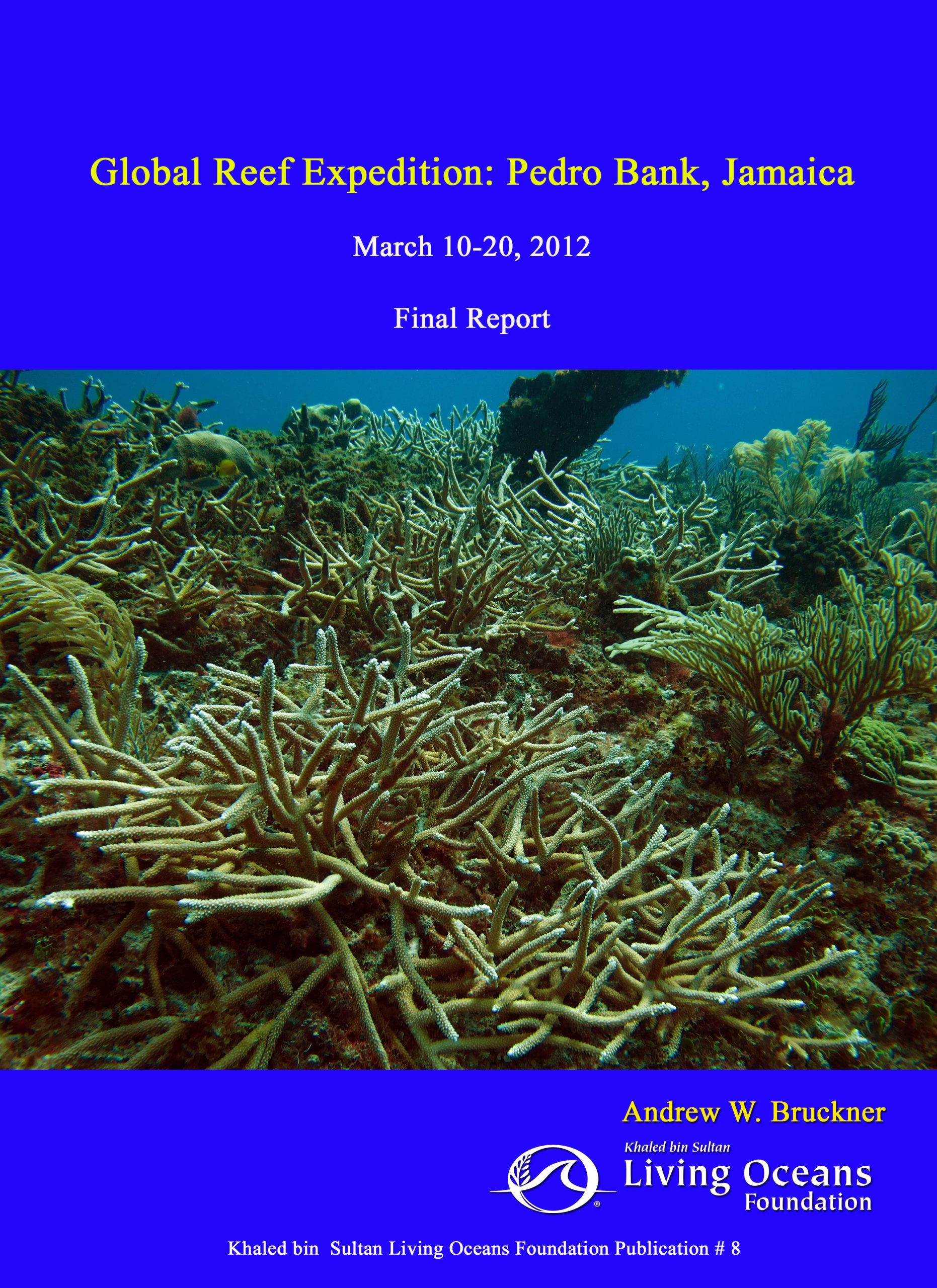
The Khaled bin Sultan Living Oceans Foundation (KSLOF), in partnership with The Nature Conservancy, conducted a research mission to Pedro Bank, Jamaica between March 10-20, 2012 as part of the Global Reef Expedition. The research team included scientists from KSLOF, The Nature Conservancy, the National Environment and Planning Agency of Jamaica (NEPA), Fisheries Division and Veterinary Services Division of the Ministry of Agriculture & Fisheries; the University of the West Indies, NOVA Southeastern University’s National Coral Reef Institute (NCRI), the Florida Aquarium, and the Atlantic and Gulf Rapid Reef Assessment Program. The main objectives of the research were to : 1) characterize the distribution, structure and health of coral reefs; 2) evaluate the population status of reef fishes and invertebrates targeted by commercial and subsistence fisheries, including top predators, parrotfishes and surgeonfishes, lobsters and conch; 3) test the use of side scan sonar as a tool to map the
distribution of shallow marine habitats; 4) obtain plankton samples to characterize the distribution, diversity and size of larval fish, conch and lobster populations; 5) conduct habitat surveys and collect oceanographic information on currents, temperature and circulation; 6) collect observational data on sea turtles, seabirds, sharks, marine mammals, and unusual floating aggregations of Sargassum seaweed. A primary emphasis of the work was placed on the proposed fishery reserve, with efforts to characterize coral communities and associated species and habitats within and outside the conservation zone. Other goals include: 1) the identification of other potential sites for consideration as marine protected areas; 2) characterization of the existence and condition of reefs within proposed mineral and oil exploration areas at the southwestern end of the bank; and 3) communication and outreach efforts directed towards
fishing communities and government agencies, including production of media.
The research team assessed the coral reef community structure at 20 sites: 18 fore reef locations and two patch reefs. At each site, at least one 10 m X 1 m photo-transect was taken. A subset of reef fish (approx. 70 species) was quantified (abundance and biomass) within 187 belt transects (each 30 m X 2 m) with additional roving surveys to characterize the entire reef fish diversity using REEF methodology. The size and condition of approximately 3000 corals were assessed within 74 belt transects (each 10 m X 1 m). Benthic assessments using a point count method were conducted on 158 transects (each 10 m in length; 100 points). Motile invertebrates (lobster, conch, crabs, sea cucumbers and sea urchins) were counted in each location within circular plots (each 314 m2 area). The team completed 252 dives and a total bottom time of 202 hours.
Additional data collected included 1) CTD deployments at each coral survey site to obtain salinity and temperature profiles from the surface to the bottom; 2) continuous temperature recordings at the anchorage of the Golden Shadow off southeast Cay; 3) current data, along with temperature, oxygen and turbidity using a Recording Doppler Current Profiler (RDCP) deployed at 20 m depth in Site 3; 4) side scan sonar data of each habitat class located near the fishery reserve; and 5) ichthyoplankton, phytoplankton and epiphytic algae samples. Within the proposed fishery reserve, a total of 15 sq km of backscatter data and 96 drop camera videos were acquired. In addition, 10 ichthyoplankton surveys were completed within the proposed boundaries of the fishery reserve. Two fishermen’s workshops (Middle Cay, Pedro Bank and Port Antonio), an educational workshop for school children (Port Antonio); fishery assessments on Pedro Bank and on the north coast of Jamaica (St. Ann’s Bay); and rapid coral assessments on the north coast (Discovery Bay, St. Ann’s Bay and Port Antonio) were also undertaken.