search-icon
Lamellodiscus Euzeti N. SP. (Monogenea: Diplectanidae), a parasite from Dentex canariensis and D. gibbosus (Teleostei: Sparidae) in the Atlantic Ocean and Mediterranean Sea. Parasite-Journal De La Societe Francaise De Parasitologie 18:145-150

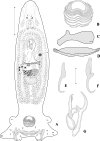
Lamellodiscus euzeti n. sp. (Monogenea:Diplectanidae) is described from the gills of two sparid fishes, Dentex canariensis (Steindachner) off Senegal and Ivory Coast and D. gibbosus (Rafinesque) off Senegal and Tunisia. The new species belongs to the “ignoratus” group, characterized by a lamellodisc with complete lamellae, a “lyre” shaped male copulatory organ type, and the “ignoratus” sensu stricto subgroup, characterized by a haptor with simple lateral dorsal bars. Lamellodiscus euzeti n. sp can be distinguished from all the congeneric species of the “ignoratus” subgroup by the presence of a prominent protuberance at the base of the curved part of the simple piece of the male copulatory organ (MCO), a large bulb at the base of the bifurcated piece of the MCO and the presence of 5-6 spines in the distal portion of the axial branch of the bifurcated piece of the MCO. Specificity and biogeography of Lamellodiscus species from sparid fishes are discussed.

Images from this publication.See all images (2)Free text
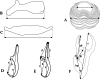
Lamellodiscus EuzetiLamellodiscus Euzeti

Related Posts

Ten Years of B.A.M.: Rooted in Partnership, Growing in Purpose

Ten years ago, the Bahamas Awareness of Mangroves (B.A.M.) program began with a simple but meaningful commitment: to connect Bahamian students with the mangrove ecosystems that shape and protect their island home.

Since 2015, B.A.M. has been implemented in partnership with Friends of the Environment, whose dedication to environmental stewardship in Abaco has made this program possible year after year. Together, we have worked alongside Patrick J. Bethel High School and Forest Heights Academy to bring hands-on mangrove science into classrooms and out into the field.

What makes ten years remarkable is not just longevity — it is consistency…

Read More

From Mangrove Mud to Meaningful Work: Desta’s J.A.M.I.N. Journey

Some students I remember for their grades, their quick answers, or a moment that made the whole class laugh. Others I remember for the way they stepped into the mangroves.

Desta was the kind of student who thrived outdoors. While some students hesitated at the edge of the mud, he walked right in. And when he inevitably got stuck — because everyone does — he didn’t get frustrated. He laughed. Covered in mud, holding mangrove propagules in his hands, he embraced the experience fully.

Even then, it was clear that he was connecting with the environment in a way that went beyond the lesson plan…

Read More