search-icon
The Rays of BIOT

Expedition Log: BIOT – Day 15

The science team is always eager to see rays during any dive, and diving in the British Indian Ocean Territory (BIOT) hasn’t disappointed us when it comes to majestic ray encounters. During our first day of diving, a group of Living Oceans Foundation scientists were approached by an inquisitive and enormous reef manta ray (Manta alfredi). By day three our manta ray count was already up to five individuals, and we continue to see them throughout the lagoon, fore reef, and channel dives.
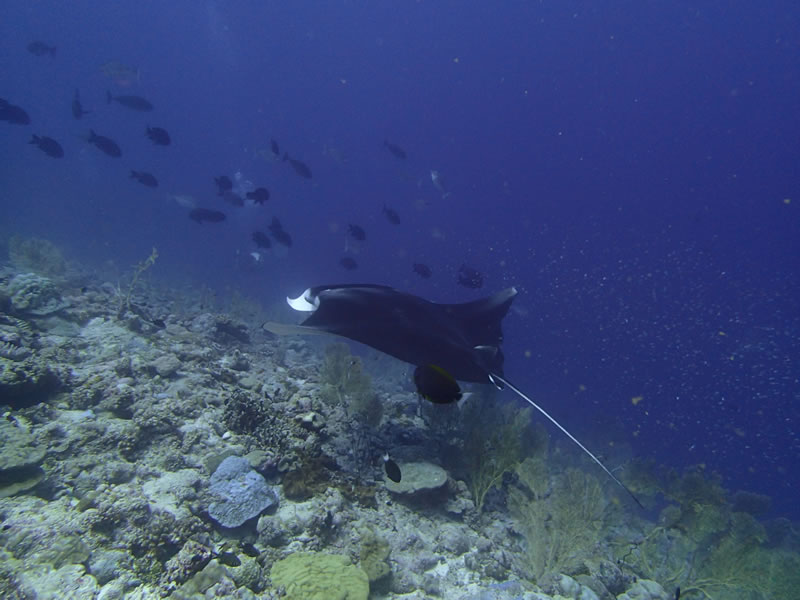
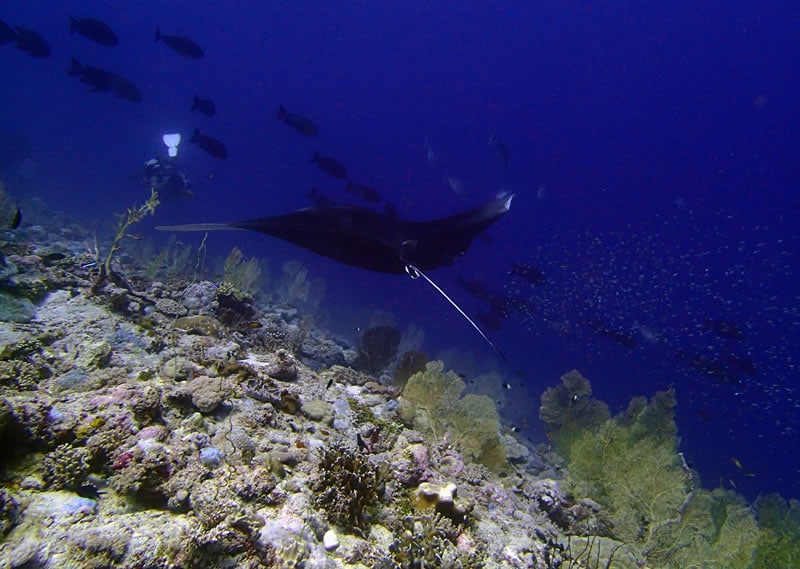
1. Manta ray encounter day 1. Photo Anderson Mayfield 2. Manta ray encounter day 1. Photo Anderson Mayfield
3. Manta ray encounter day 1. Photo Anderson Mayfield 4. Manta ray encounter day 1. Photo Anderson Mayfield
Our encounter with a reef manta ray on our first day of diving.
(click-thru on images for greater detail)

There are three families of rays found in BIOT: Dasyatidae, Myliobatidae and Mobulidae. Reefs here contain approximately eight ray species:

  • reef manta ray ( alfredi)
  • cowtail stingray (Pastinachus sephen)
  • spotted eagle ray (Aetobatus narinari)
  • devil ray (Mobula japonica)
  • porcupine rays (Urogymnus asperrimus and africanus)
  • mangrove whipray (Himantura granulata), and the
  • marbled ray (Taeniura meyeni).

So far we have seen the first five species in this list and we hope to see the remaining three before we leave BIOT.
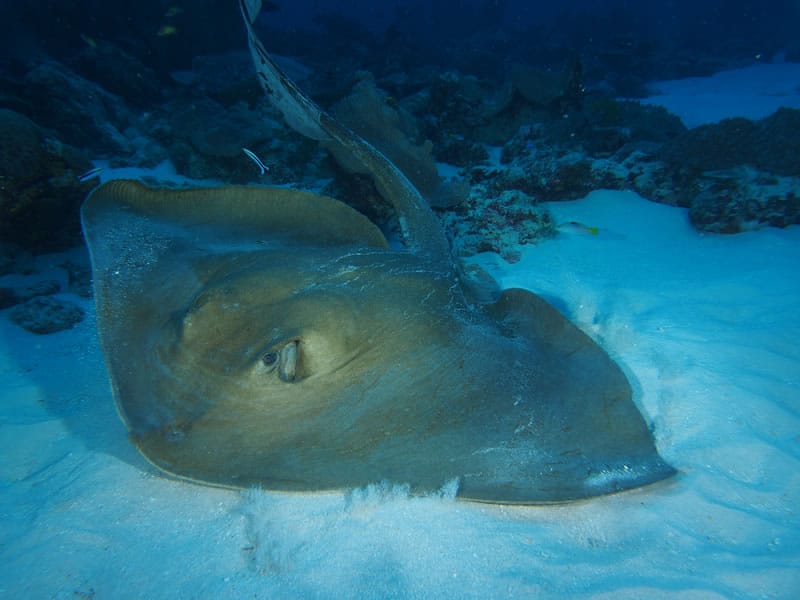
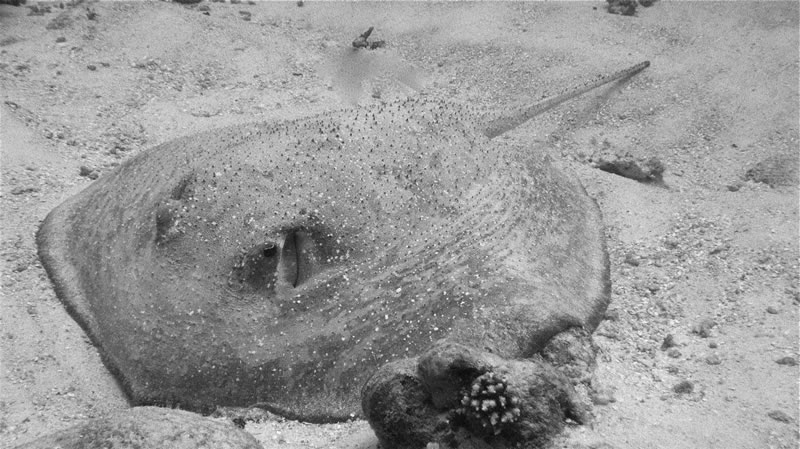
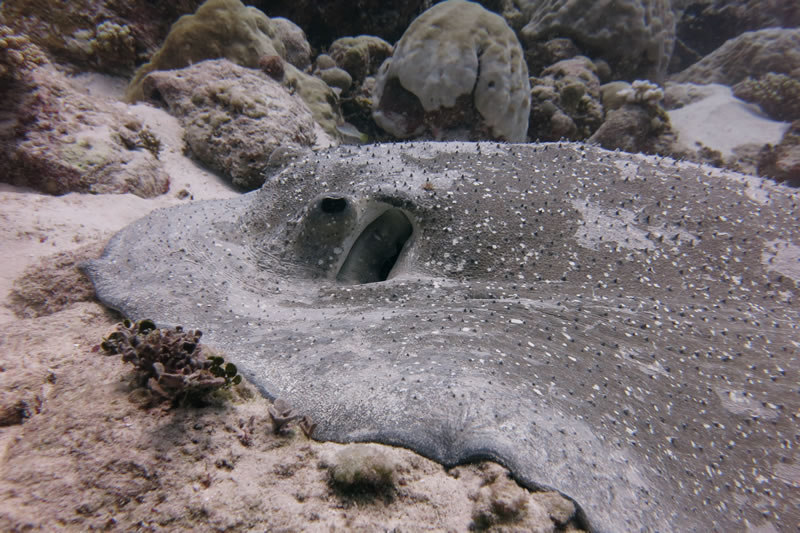
cowtail stingray Andy Bruckner marbled ray (Taeniura meyeni).  Photo by Stefan Andrews
Porcupine ray (Urogymnus asperrimus). Photo Kate Fraser porcupine ray  Sam Clements
Cowtail stingray (upper left) / Marbled ray (upper right) / Porcupine rays (U. asperrimus and africanus) (bottom)
(click-thru on images for greater detail)

We are incredibly fortunate to see such large individuals and such a high diversity of rays. Rays tend to be characterised by their low fecundity (number of pups per reproductive season), late age at sexual maturity, long inter-birth intervals and slow growth rates.

The reef manta is one of the largest rays found in BIOT, reaching a wingspan of up to 4.5 m. These enormous rays can live up to 100 years, and won’t reach sexual maturity until 15 to 20 years old, having one pup every two to three years after this.

Reef manta ray
Reef manta ray.

One of my personal favorites, the spotted eagle ray, a more common but an equally majestic ray, can reach a wingspan of 3 m and doesn’t reach sexual maturity until 4 to 6 years of age.

spotted eagle ray Andy Bruckner
Spotted eagle ray.

These life-history characteristics increase the vulnerability of many rays to the growing direct and indirect fishing pressure around the world. The protection of BIOT’s reefs from fishing most likely explains why we are having these amazing ray encounters during many of our dives here.


Photos: 1-4 Anderson Mayfield, 5,10-Andrew Bruckner, 6,9-Stefan Andrews, 7-Kate Fraser, 8-Samantha Clements


Related Posts

After the Storm: Standing with Our J.A.M.I.N. Family in Jamaica

There are moments in this work that feel heartbreakingly familiar.

Two weeks after we completed our Jamaica Awareness of Mangroves in Nature (J.A.M.I.N.) programming, Hurricane Melissa made landfall. A powerful Category 5 hurricane, Melissa is now tied with Hurricane Allen in 1980 for the strongest winds ever recorded in an Atlantic storm. Like Hurricane Dorian, which devastated The Bahamas in 2019, Melissa will be remembered as one of the strongest hurricanes on record in the region.

For 11 years, the University of the West Indies Discovery Bay Marine Laboratory and William Knibb Memorial High School have been more than program partners. They have welcomed us into their classrooms and labs, shared meals and laughter, and committed themselves to educating their students about mangroves and coastal resilience. These colleagues and students are not distant collaborators. They are family.

And they were hit hard…

Read More

B.A.M. Turns 10: A Year of Milestones, Resilience, and Growth

The 2025–2026 academic year was one of those defining years for our Bahamas Awareness of Mangroves (B.A.M.) and Jamaica Awareness of Mangroves in Nature (J.A.M.I.N.) programs. It was a year marked by celebration, challenge, growth, and powerful full-circle moments, and a reminder of why mangrove education matters.

In The Bahamas, B.A.M. reached a major milestone: ten years of partnership and environmental education in Abaco. Since 2015, in collaboration with Friends of the Environment, we have worked alongside Patrick J. Bethel High School and Forest Heights Academy to bring hands-on mangrove science into classrooms and into the field. This year, we were proud to expand the program to S.C. Bootle High School, increasing access for students who live…

Read More
Privacy Overview

This website uses cookies so that we can provide you with the best user experience possible. Cookie information is stored in your browser and performs functions such as recognising you when you return to our website and helping our team to understand which sections of the website you find most interesting and useful.  You can view our complete Privacy Policy here.

Strictly Necessary Cookies

Most of our cookies are used to improve website security and reduce spam. These cookies should be enabled at all times. They also enable us to save your preferences for cookie settings.

3rd Party Cookies

This website uses Google Analytics to collect anonymous information such as the number of visitors to the site, and the most popular pages. Keeping this cookie enabled helps us to improve our website.