Expedition Log: Cook Islands – Day 1
Over the last four years, the Global Reef Expedition (GRE) has focused on the Pacific and Indian Ocean. These reefs are vastly different from Caribbean reefs, especially with regards to the numbers of species of corals, fish and other organisms. Yet, many of the large scale threats are similar – bleaching, coral diseases, overfishing and land-based pollution to name a few. One of the most pervasive and destructive threats to Indo-Pacific corals, absent from the Caribbean, is Acanthaster planci – better known as crown of-thorns starfish (COTS). In every Indo-Pacific country surveyed during the GRE we have identified reefs that have been devastated by COTS, and many more that are currently under attack.


Locations we’ve examined in the Pacific and Indian Ocean during the GRE (left).
Satellite image of Aitutaki atoll (right).
We’ve mentioned these voracious coral predators (corallivores) in previous blogs. We have witnessed their destructive potential, seen active outbreaks spread through a reef system, and documented the extent of coral loss on affected reefs. We have also removed hundreds of these animals from certain reefs and in 2013 we attempted our first large scale removal from an entire atoll – Aitutaki – in the Cook Islands.
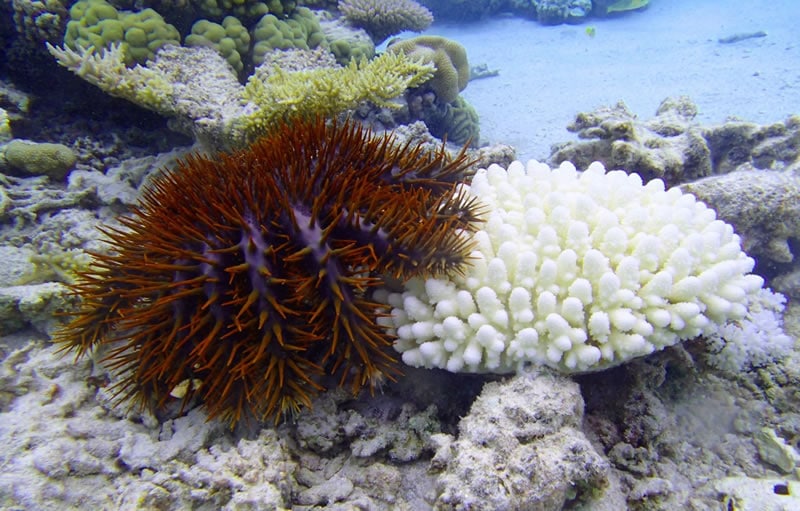
Crown of thorns eating Acropora corals in Aitutaki.
As the Foundation completed baseline surveys and research during the GRE we have acquired a much better understanding of the current status of reefs, the threats that affect them, and factors that help them persist and recover following large scale disturbances. Over the next decade we will begin implementing programs to use our scientific knowledge to take action, through on-the-ground conservation and ecological restoration programs. The first of these is the Starfish Control and Removal Program (SCAR).

Badly damaged reef in Aitutaki during the original outbreak in 2013.
The SCAR program will expand our scientific understanding of COTS, mitigate damage through large-scale COTS removal efforts, and educate local communities, dive operators, resource management agencies and tourists in affected countries on the ecology of these starfish and techniques to control outbreaks.

Andy collecting crown of thorns.
Our pilot SCAR program has just begun. We have returned to Aitutaki two years after our initial removal effort. We are here to assess the extent of recovery in areas damaged by COTS, and to remove starfish from additional locations currently containing large numbers of these starfish. Through collaboration with the Ministry of Marine Resources, Aitutaki’s Traditional Leaders, Aitutaki Conservation Trust, and the Aitutaki Marine Research Centre, we hope to prevent additional impacts to Aitutaki’s reefs, while raising awareness of these deadly starfish.
Photos: 3,5 Ken Marks, 4 Andrew Bruckner.